
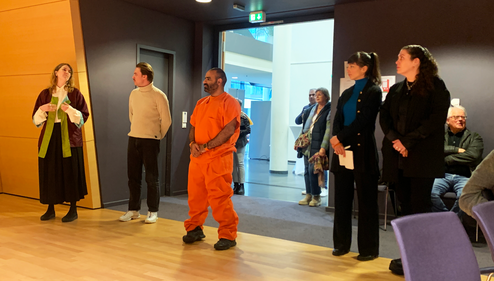
The closing event for the exhibition “(In)visibility of violence” took place on November 2, 2025. To conclude the exhibition, the curators, Theresa Deichert, Larissa-Diana Fuhrmann, and Nadia Ismail, invited visitors to participate in a dialogue format entitled “10 Questions for …”. At three themed tables, the audience engaged in conversation with artist Jonas Höschl, Mansoor Adayafi – a former Guantánamo detainee and author – as well as Tina Cramer, TraCe knowledge transfer officer, and the curators themselves. Adayafi wore orange prison garb, visibly recalling the violence he had experienced. During the discussion rounds, participants talked about artistic methods, personal experiences, violence, social responsibility, and the connection between art and research. The exchange continued during the get-together in the foyer afterwards.
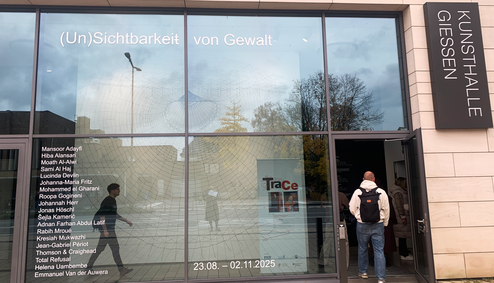
Over a period of ten weeks, the multimedia exhibition explored the question of how art makes violence visible – or conceals it. In collaboration with the Research Center “Transformations of Political Violence (TraCe)”, the exhibition presented international artistic perspectives that documented, embodied, or critically reflected on violence in its various forms. Nadia Ismail, Theresa Deichert, and Larissa-Diana Fuhrmann curated the exhibition.
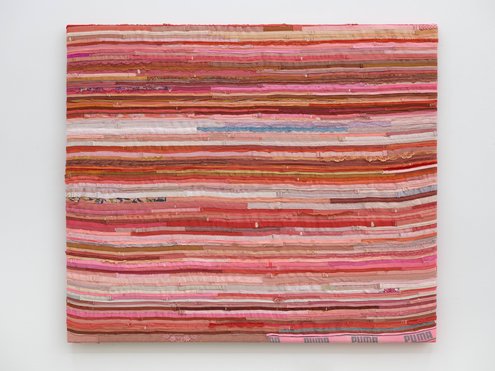
The exhibition focused not only on the obvious images of war and destruction, but also on the less visible dimensions of violence, such as structural, psychological, and gender-specific violence – often overlooked and socially repressed. The works explored who decides what is shown and what remains hidden, and how this can be made visible through art. Overall, the exhibition encouraged visitors to question their viewing habits and engage with underlying power structures.
The exhibition was therefore not only an artistic project, but also a space for research and discussion – as was emphasized by Giessen’s mayor Frank-Tilo Becher in his welcoming speech at the opening on August 22, 2025.
A diverse program of events furthered the discussion: The “Art and Coffee” format invited visitors to participate in an open exchange on September 24. “Art Buzz” offered short tours and refreshments for young culture enthusiasts on September 18. On October 1, the Kunsthalle screened Laura Poitras’s 2013 documentary film “Death of a Prisoner.” Larissa-Diana Fuhrmann and Sebastian Köthe then reflected on the documentary film about the repatriation of Guantánamo prisoner Adnan Latif's body to Yemen in a subsequent discussion.
During its ten-week run, more than 2,200 people, including several school classes, attended the exhibition at the KUNSTHALLE GIESSEN. Despite its slightly shorter run, this made the exhibition one of the Kunsthalle’s most visited exhibitions.
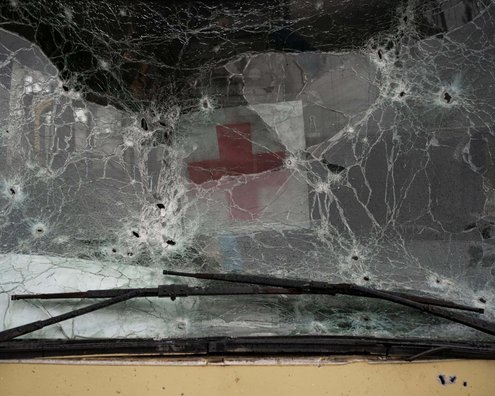
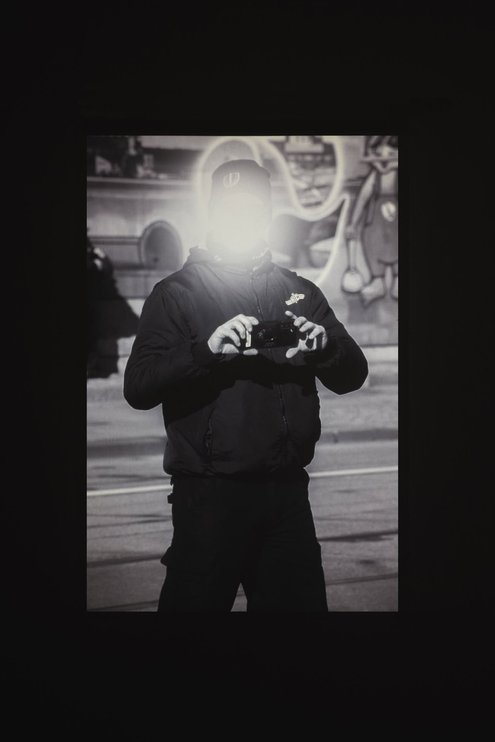
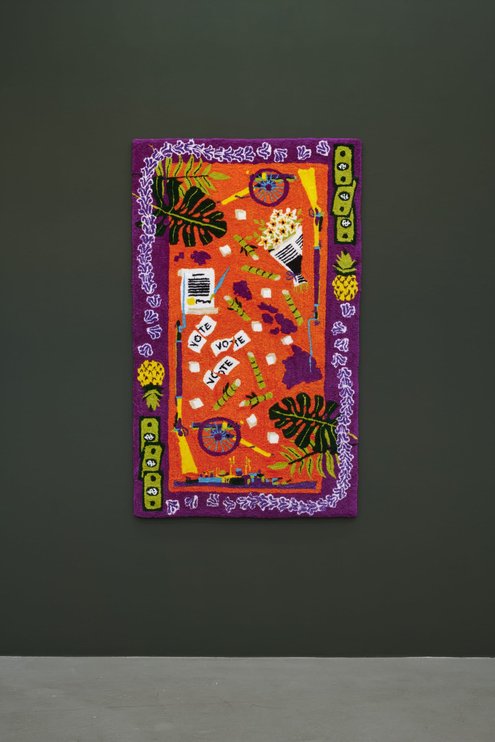
The topic maintains its relevance even after the exhibition’s conclusion: The exhibition opening was accompanied by the publication of TraCe Working Paper No. 6. With a foreword by Larissa-Diana Fuhrmann and Tina Cramer, the publication examines the mechanisms that shape the visibility or invisibility of violence and how violence is documented, instrumentalized, or censored. Contributions come from TraCe researchers and Kunsthalle director Nadia Ismail.
Additionally, KUNSTHALLE GIESSEN, in collaboration with TraCe, has published a journal to complement the exhibition. The journal provides deeper insight into the exhibition’s content and issues. The theoretical texts by authors and curators are accompanied by biographies of the participating artists and installation views from the Kunsthalle.