
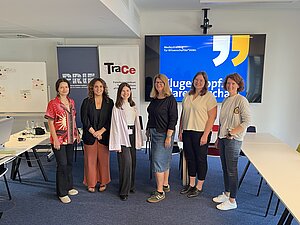
On July 23, 2026, an advanced media training session for TraCe researchers took place at the PRIF in Frankfurt. Five researchers from the TraCe Early Career Researchers (ECRs) network took part in the workshop led by Monika Wimmer. The training was organized by coordinator Tina Cramer and was designed as a follow-up to the basic training.
At the beginning of the training, there was a recap on clear, understandable language and the formulation of striking key messages, before the workshop’s focus shifted to communication at the intersection of science and politics. Together, the participants discussed communication goals, different target audiences, and their own roles as researchers in dialogue with political decision-makers. The discussion also addressed the expectations that policymakers have of scientific expertise and how research findings can be effectively communicated.
The program also included a session on narrative communication strategies. Using storytelling methods, story arcs, and other practical tools, the participants explored how scientific content can be translated into compelling and accessible stories.
After a lunch break, the participants stepped in front of the camera themselves. In one-minute elevator pitches, they presented their own research. The focus was on aspects such as body language, eye contact, and coming across as authentic to the listener. At the end of the workshop, the group focused on how to handle critical and confrontational questions. To this end, conversation techniques were also introduced to help participants remain composed even in challenging conversational situations.
In addition to the professional insights, the workshop provided plenty of opportunity for a stimulating exchange. The participants took advantage of the opportunity to discuss open questions and reflect on experiences from past years with a trainer who brought a journalistic perspective to the session.