
Russia, China, and the U.S.: Recent developments show that powerful states are increasingly testing the limits of their assertions of power against other states. To this end, they are using economic and political pressure, making less and less distinction between permissible and impermissible means.
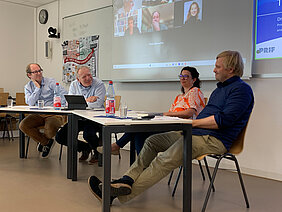
On July 8, 2026, TraCe researchers, students, and guests discussed this “New Interventionism” at Justus Liebig University Giessen.
In the first of two discussion rounds, Lisbeth Zimmermann, Raphaël Cahen, and Hendrik Simon discussed the limits of nonviolence and non-interference. The conversation focused on the various historical and contemporary forms of interventionism, the evolution of justification strategies, and the changing scope of action available to the United Nations.
During the second round of discussions, guests Barry de Vries (JLU) and Katja Schöberl (German Red Cross) examined the implications of the concept of “neutrality” for states not directly involved in armed conflicts, including their humanitarian responsibilities. The ensuing discussion focused on Iran’s recent attacks on Gulf states that consider themselves neutral but have become targets due to the deployment of U.S. military forces there.
Summarizing the discussion, organizer Thilo Marauhn stressed the importance of governments consistently upholding the law. The event concluded with an informal exchange.